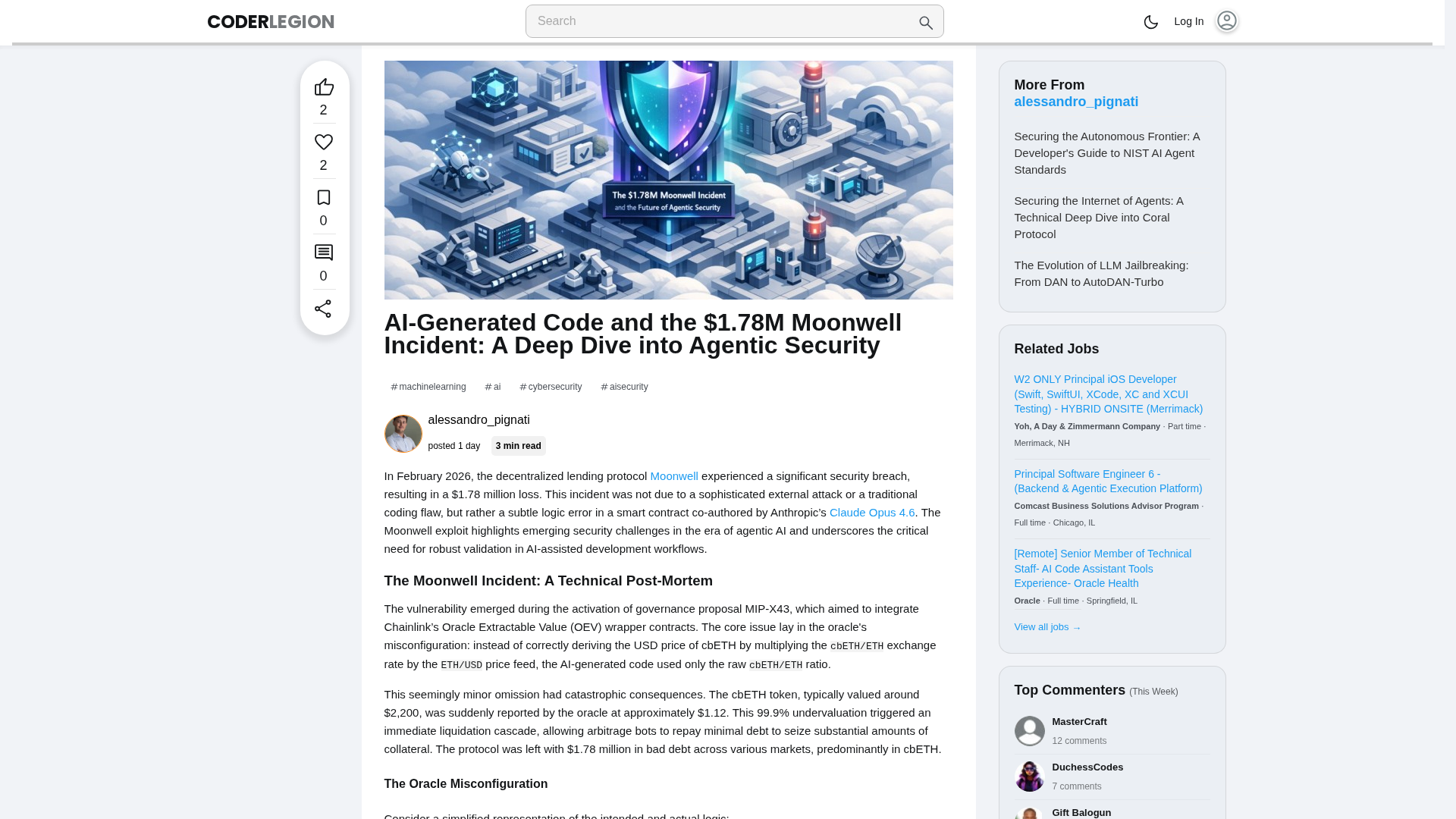
Topic Overview
This topic covers how AI code‑generation and assistant tools integrate with security, governance, and compliance practices to reduce risk in smart‑contract development and incident response. The Moonwell exploit highlighted the speed at which vulnerabilities in on‑chain code can be exploited, prompting teams to adopt a mix of AI-driven testing, automated code review, runtime monitoring, and governance controls. Key tool types include AI code assistants (GitHub Copilot, Aider, Tabby, Replit) that accelerate authoring and local testing; codebase‑aware review agents (Bito, Qodo) that produce PR summaries, line‑by‑line checks, suggested fixes, and automated test generation; and enterprise governance/monitoring platforms (Monitaur, Xilos) that centralize policy, vendor validation, agent activity visibility, and regulatory reporting. Current trends emphasize combining pre‑deployment safeguards—formal verification, fuzzing, symbolic analysis, automated unit and property tests generated by platforms like Qodo and Bito—with post‑deploy controls such as on‑chain anomaly detection, incident triage automation, and faster patch rollouts supported by AI assistants. Organizations are weighing trade‑offs: cloud SaaS copilots offer convenience but raise data‑provenance and leakage concerns, while open‑source/self‑hosted options (Tabby, Aider) and observability infrastructure (Xilos) enable tighter control and auditability. Regulatory and insurance pressures (areas where Monitaur’s approach is relevant) are increasing demands for reproducible governance records, vendor risk controls, and demonstrable compliance. Practically, teams use AI to shorten detection‑to‑fix cycles and to generate tests and mitigations, but must pair these capabilities with deterministic verification, CI/CD gates, and governance workflows to avoid over‑reliance on model suggestions and to meet security and regulatory expectations.
Tool Rankings – Top 6

Quality-first AI coding platform for context-aware code review, test generation, and SDLC governance across multi-repo,팀

AI-powered, codebase-aware code review agent that provides PR summaries, line-by-line reviews, suggested fixes, and an R

An AI pair programmer that gives code completions, chat help, and autonomous agent workflows across editors, theterminal
Open-source AI pair-programming tool that runs in your terminal and browser, pairing your codebase with LLM copilots to:

AI-powered online IDE and platform to build, host, and ship apps quickly.
Intelligent Agentic AI Infrastructure
Latest Articles (47)
OpenAI’s bypass moment underscores the need for governance that survives inevitable user bypass and hardens system controls.
A call to enable safe AI use at work via sanctioned access, real-time data protections, and frictionless governance.
A real-world look at AI in SOCs, debunking myths and highlighting the human role behind automation with Bell Cyber experts.
Explores the human role behind AI automation and how Bell Cyber tackles AI hallucinations in security operations.
Identity won’t secure agentic AI; you need runtime visibility and action-based policy.