
Overview
Gradient AI delivers enterprise AI solutions for the insurance industry, focusing on underwriting and claims. The platform leverages large proprietary datasets (tens of millions of policies and claims) and specialized datasets (e.g., SAIL for group health) to provide risk scoring, predictive claims models, pricing support, and decision automation. Use cases include faster quote turnaround, more accurate pricing, improved loss ratios, reduced claims costs, and straight-through processing for low-risk business. Gradient AI emphasizes security and compliance (SOC 2 and HITRUST) and positions the product as a measurable ROI tool for carriers, MGUs, captives, and third-party administrators. Founded in 2018; Series C $56.1M announced July 2024.
Key Features
AI Risk Scoring (Workers’ Comp)
Generates granular, real-time risk scores to accelerate underwriting, enable straight-through processing, and improve pricing decisions by integrating large datasets.
SAIL Dataset & Group Health Underwriting
Specialized medical and prescription dataset (SAIL) plus ML models to produce faster, more accurate group health quotes and pricing.
Claims Prediction Suite
Commercial-auto and other lines: Risk Ranking, Total Incurred Prediction (TIP), Legal Engagement forecasts, and Litigation Probability to identify high-cost claims and enable proactive interventions.
Large Insurance Data Lake & Model Training
Uses tens of millions of closed claims and policies plus third-party data and proprietary features to train production models.
Integration & Decision Point Delivery
Designed to integrate with existing underwriting and claims workflows to deliver AI insights at the point of decision.
Security & Compliance
SOC 2 and HITRUST certifications aimed at regulated enterprise customers.
Who Can Use This Tool?
- Insurers:Underwrite policies and price risk more accurately using AI-driven risk scores and datasets.
- Claims Teams:Identify high-cost claims early and prioritize interventions to reduce duration and cost.
- Group Health Carriers:Use SAIL-powered models to speed quotes and improve group health pricing and competitiveness.
- MGUs & Captives:Leverage predictive analytics to expand into markets confidently and improve loss ratios.
Pricing Plans
Pricing information is not available yet.
Pros & Cons
✓ Pros
- ✓Industry-focused: Built specifically for insurance underwriting and claims workflows.
- ✓Rich data: Models trained on tens of millions of policies and claims plus proprietary datasets (SAIL for group health).
- ✓Measurable ROI: Customer-reported savings and case studies cited (e.g., >$300M savings referenced in site materials).
- ✓Security and compliance: SOC 2 and HITRUST certifications called out for enterprise trust.
- ✓Broad solutions: Underwriting risk scores, claims predictions (risk ranking, total incurred prediction, litigation probability), and group health solutions.
✗ Cons
- ✗No public pricing or plans: Enterprise sales / contact-first approach makes evaluation harder for buyers seeking transparent pricing.
- ✗Enterprise integration likely required: Implementation and data integration effort implied.
- ✗Limited public documentation: No detailed public developer docs or API docs discovered on the main site.
Compare with Alternatives
| Feature | Gradient AI | Simplifai | Sema4.ai |
|---|---|---|---|
| Pricing | N/A | N/A | N/A |
| Rating | 8.0/10 | 8.3/10 | 8.1/10 |
| Risk Modeling Depth | Specialized extensive insurance risk models | Shallow risk modeling capabilities | Agent focused platform limited insurance risk models |
| Claims Automation Coverage | Yes | Yes | Partial |
| Data Platform Integration | Large insurance data lake enterprise integrations | API integrations moderate data platform connectivity | Snowflake native zero copy data integration |
| Model Training & Retraining | Yes | Partial | Partial |
| Explainability & Auditability | Partial | Partial | Yes |
| Workflow Automation & Agents | Partial | Yes | Yes |
| Integration & Decisioning | Yes | Yes | Yes |
Related Articles (2)
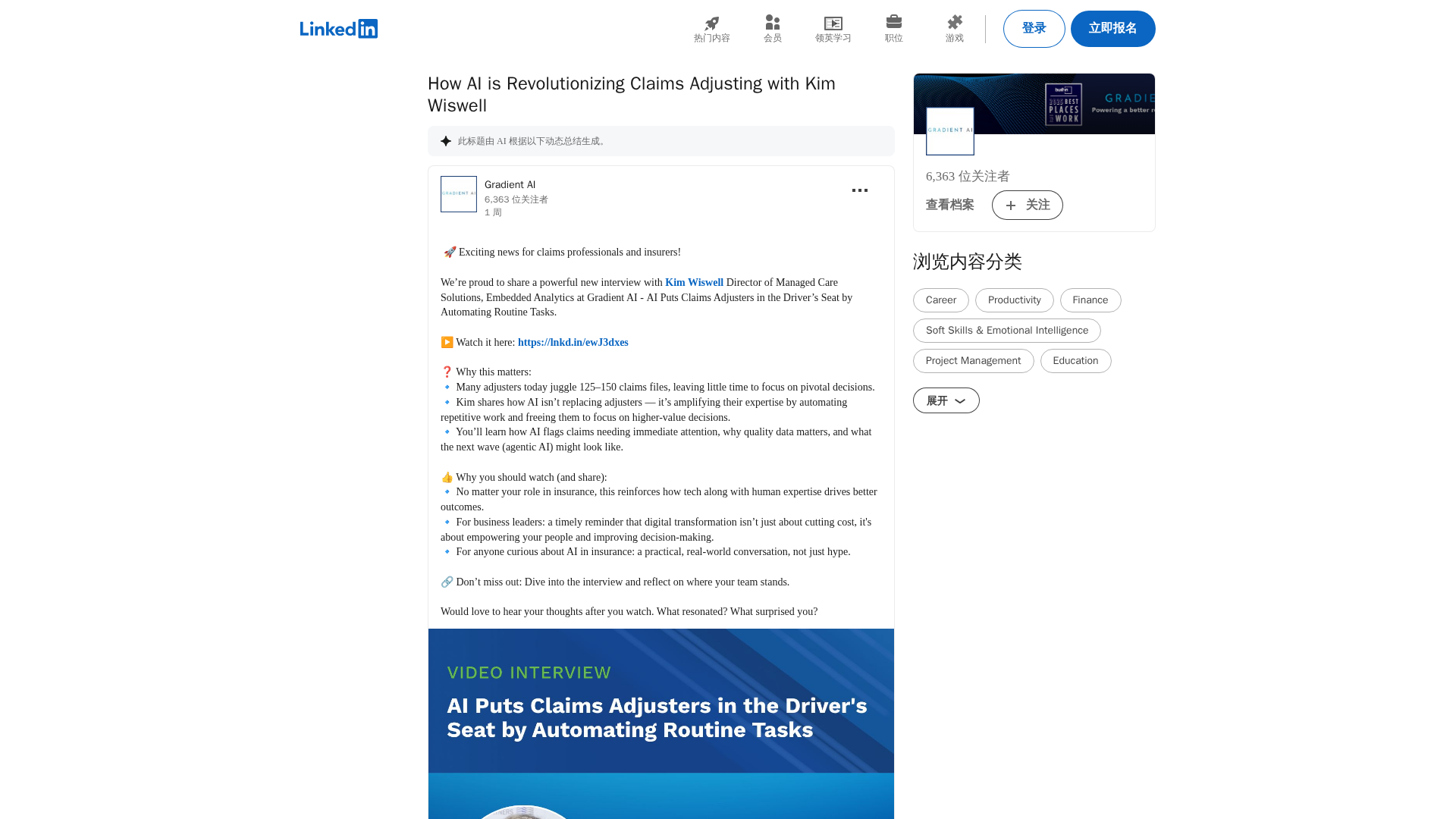
Kim Wiswell explains how AI amplifies claims adjusters by automating routine tasks, improving data quality, and enabling agentic AI in real-world insurer workflows.
Explores how agentic AI blends speed, automation, and human empathy to transform claims, onboarding, and customer service in insurance.