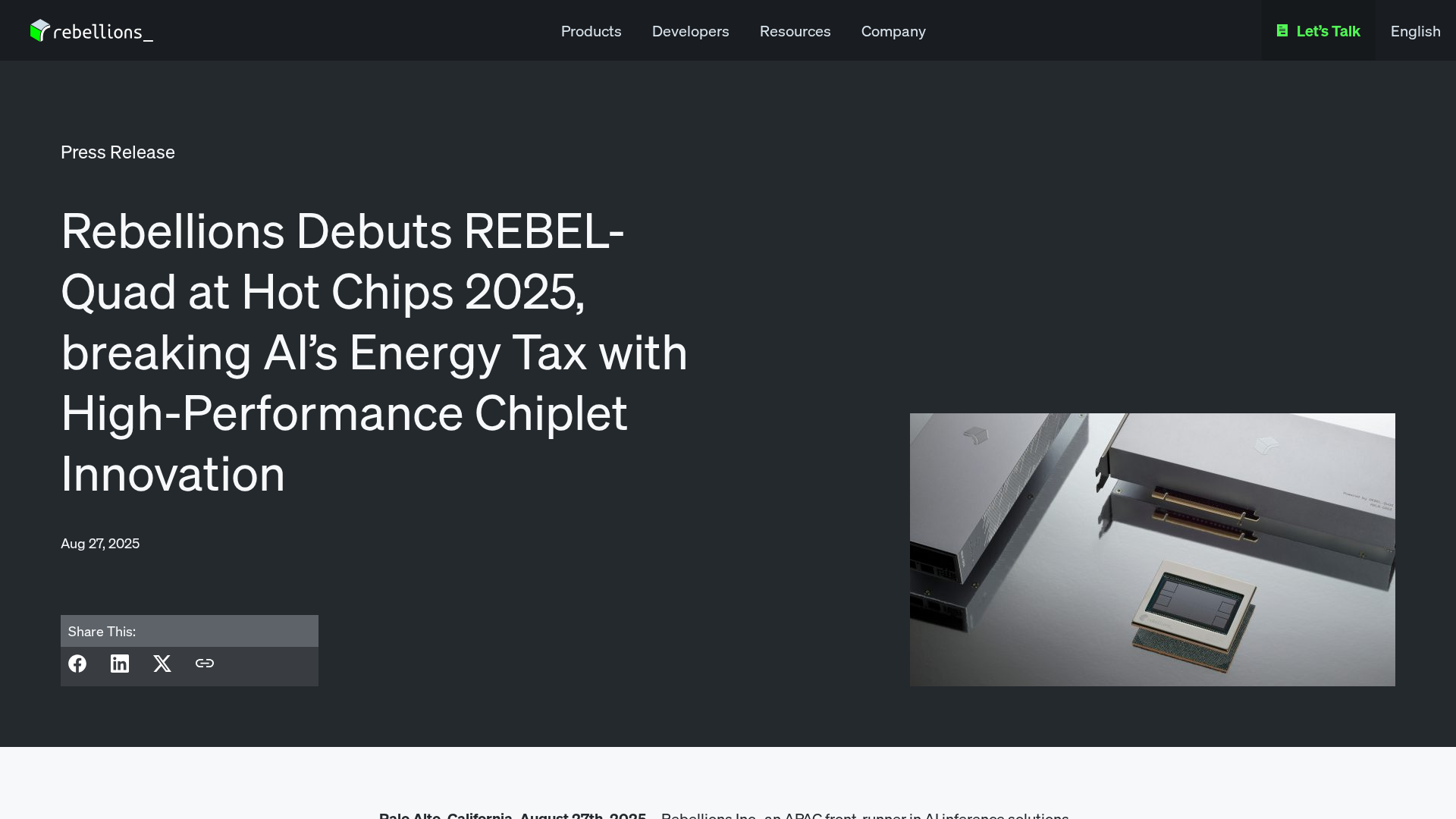
Topic Overview
This topic examines how photonic accelerators such as the LightGen chip compare to incumbent GPU platforms (NVIDIA H100/H800) and emerging alternatives in the context of decentralized AI infrastructure. Photonic chips aim to move data and perform some operations using light, promising higher interconnect bandwidth and potentially lower energy per bit for large‑scale inference and model serving. By contrast, NVIDIA’s H100/H800 remain the dominant, general‑purpose accelerators with mature software ecosystems and broad model compatibility. Relevance as of 2025-12-19: demand for energy‑efficient inference at hyperscale and constrained-edge deployments has grown, prompting interest in specialized accelerators and heterogeneous stacks. Tool and market signals reinforce this shift: Rebellions.ai is building GPU-class software and purpose-built inference accelerators (chiplets, SoCs, servers) aimed at high-throughput, energy‑efficient LLM and multimodal inference; the Deci.ai site audit highlights consolidation in the acceleration and optimization space following NVIDIA’s May 2024 acquisition of Deci, underscoring vendor consolidation and software integration trends. Meanwhile, edge-focused models like Stability AI’s Stable Code family illustrate demand for smaller, private, instruction‑tuned models that benefit from low-latency, energy‑efficient hardware. Key considerations when comparing LightGen, H100/H800 and alternatives include raw throughput, latency for real‑time inference, software ecosystem and toolchain maturity, model format and quantization support, deployment scale, and total cost of ownership including energy. The practical choice often blends accelerators (photonic, GPU, ASIC) with software stacks for model compression and orchestration. For decentralized AI infrastructure, interoperability, open standards, and proven software support are as important as theoretical hardware gains.
Tool Rankings – Top 3

Energy-efficient AI inference accelerators and software for hyperscale data centers.

Site audit of deci.ai showing NVIDIA takeover after May 2024 acquisition and absence of Deci-branded pricing.

Edge-ready code language models for fast, private, and instruction‑tuned code completion.
Latest Articles (15)
ProteanTecs expands in Japan with a new office and Noritaka Kojima as GM Country Manager.

Rebellions names a new CBO and EVP to drive global expansion, while NST commends Qatar’s sustainability leadership.

Rebellions appoints Marshall Choy as CBO to drive global expansion and establish a U.S. market hub.
Comprehensive upgrade of ClusterMAX ranks 84 GPU clouds across 10 criteria with 140+ end-user interviews.
A comprehensive 2025 comparison of 12 cloud GPU providers for AI/ML, covering hardware, pricing, scalability, and deployment options.