
Topic Overview
This topic compares managed AI inference delivered from traditional cloud GPU fleets with emerging decentralized and edge-based inference infrastructures. It covers orchestration, hardware heterogeneity, energy efficiency, latency, cost predictability, and data governance as operators choose where to host models and route requests. As of 2025-11-25, demand for low-latency, privacy-preserving inference and lower operational carbon footprints has pushed hybrid deployment patterns and new orchestration layers. Key tools illustrate the ecosystem: FlexAI represents software-defined, hardware-agnostic orchestration that routes workloads to optimal compute across cloud and edge resources; Rebellions.ai develops energy-efficient inference accelerators and runtime software for hyperscale data centers; Tensorplex Labs demonstrates a decentralized model-and-compute stack that combines open-source tooling with blockchain/DeFi primitives for resource allocation and incentives; OpenPipe focuses on managed model ops—collecting LLM interaction data, fine-tuning, evaluating and hosting optimized inference; Stable Code supplies edge-ready, instruction‑tuned code models for fast private completion; Activeloop/Deep Lake provides multimodal data storage, versioning and vector indexing that underpin RAG and inference pipelines. The practical trade-offs are clear: cloud GPUs give predictable SLAs, integration and scale, while decentralized/edge approaches can lower latency, reduce energy use, and improve data locality but introduce heterogeneity, variable reliability and new operational complexity. Managed inference in 2025 favors hybrid solutions—software-defined routing, specialized accelerators, and integrated data/model ops—to balance throughput, cost, privacy and compliance. Evaluation should prioritize measurable SLAs, TCO, model-update workflows, telemetry and data governance rather than vendor claims.
Tool Rankings – Top 6
%201.png)
Software-defined, hardware-agnostic AI infrastructure platform that routes workloads to optimal compute across cloud and

Energy-efficient AI inference accelerators and software for hyperscale data centers.
Open-source, decentralized AI infrastructure combining model development with blockchain/DeFi primitives (staking, cross

Managed platform to collect LLM interaction data, fine-tune models, evaluate them, and host optimized inference.

Edge-ready code language models for fast, private, and instruction‑tuned code completion.

Deep Lake: a multimodal database for AI that stores, versions, streams, and indexes unstructured ML data with vector/RAG
Latest Articles (66)

A deep dive into Akash Network, the decentralized cloud marketplace challenging traditional cloud models.
How AI agents can automate and secure decentralized identity verification on blockchain-enabled systems.

Analyzes data centers' AI-driven demand, energy and water needs, policy barriers, and routes to equitable digital infrastructure.
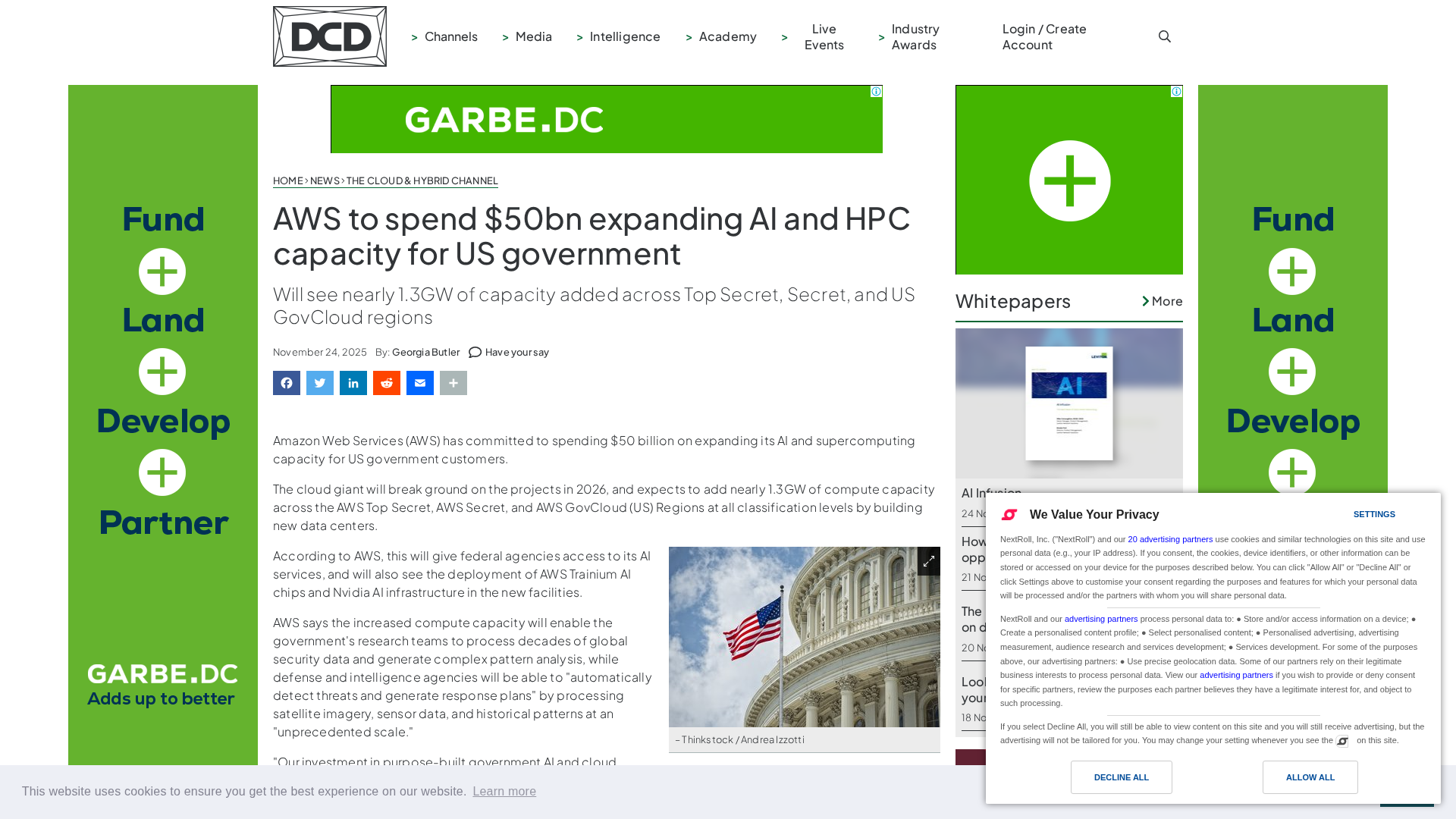
AWS commits $50B to expand AI/HPC capacity for U.S. government, adding 1.3GW compute across GovCloud regions.

Nokia unveils Autonomous Networks Fabric to accelerate AI-powered, zero-touch network automation.