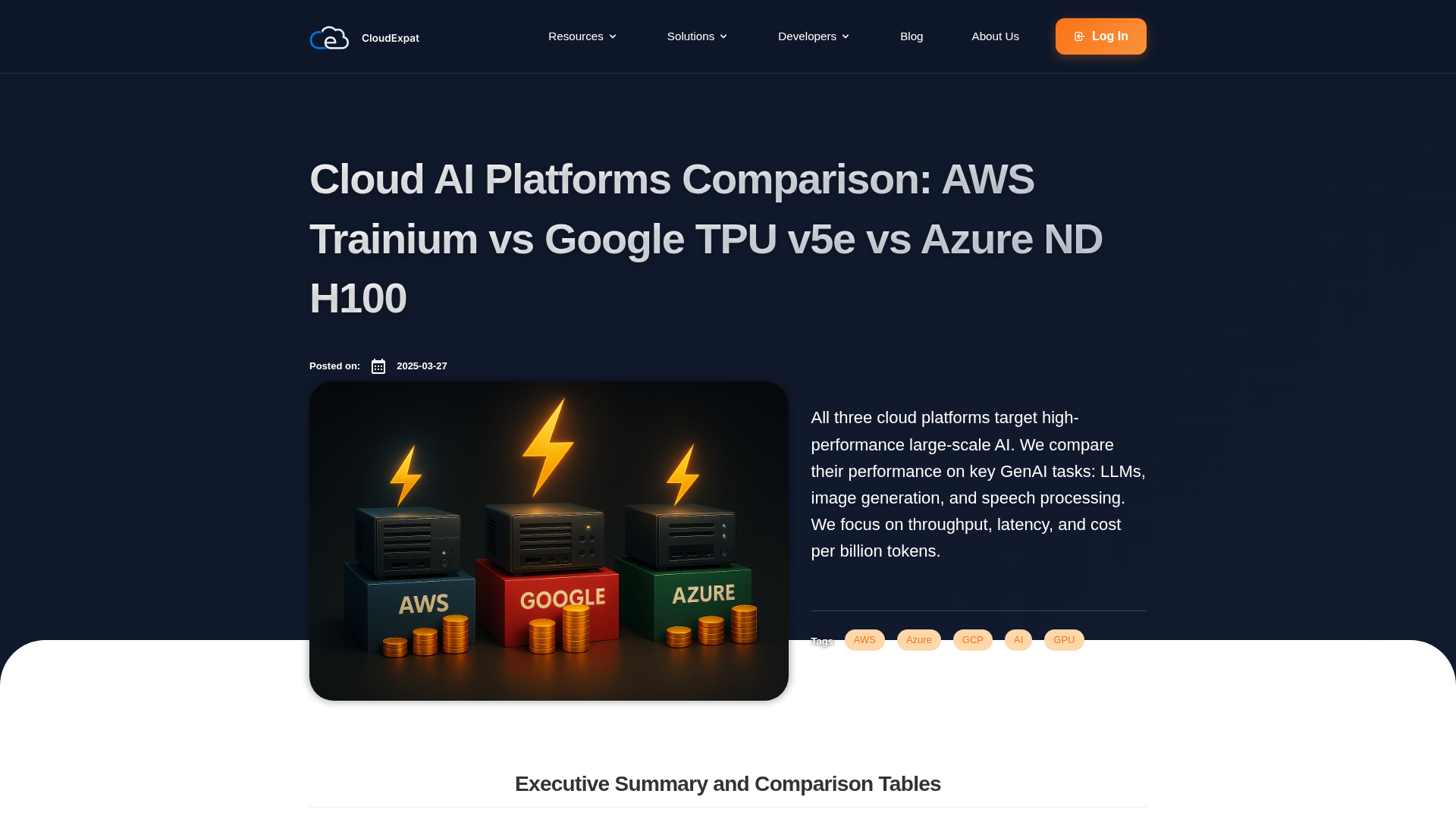
Topic Overview
Hardware‑optimized AI inference servers are purpose-built systems—exemplified by AWS Trainium and Inferentia, Google’s TPU family, and emerging chiplet/SoC designs—that maximize throughput, minimize latency, and reduce energy per inference for large language and multimodal models. This topic covers the stack from accelerator silicon and server designs to inference software, and how those components are being integrated into decentralized and edge AI infrastructure. Relevance in early 2026 is driven by three pressures: operating cost and carbon constraints at hyperscale, demand for private and low‑latency on‑prem/edge inference, and a shift toward specialized hardware and software co‑design. Providers such as Rebellions.ai are building energy‑efficient accelerators and GPU‑class software stacks for hyperscalers, while projects like Tensorplex Labs explore open, decentralized infrastructure that couples model lifecycle tools with blockchain/DeFi primitives for resource discovery and staking. Edge‑focused models such as Stability AI’s Stable Code family illustrate the use case for compact, instruction‑tuned LLMs that run on localized, optimized inference servers to preserve privacy and latency. Key considerations include hardware choices (ASICs, TPUs, chiplets), software compatibility (model formats, quantization, runtime stacks), economics (energy and utilization), and governance models for decentralized resource sharing. Together, these elements show a practical ecosystem: specialized inference hardware reduces cost and increases performance; open infrastructure and tokenized marketplaces enable distributed capacity; and compact models make safe, private edge inference achievable. This convergence informs procurement, deployment, and developer tooling decisions for organizations deploying LLMs at scale or in decentralized architectures.
Tool Rankings – Top 3

Energy-efficient AI inference accelerators and software for hyperscale data centers.
Open-source, decentralized AI infrastructure combining model development with blockchain/DeFi primitives (staking, cross

Edge-ready code language models for fast, private, and instruction‑tuned code completion.
Latest Articles (30)
How AI agents can automate and secure decentralized identity verification on blockchain-enabled systems.
AWS commits $50B to expand AI/HPC capacity for U.S. government, adding 1.3GW compute across GovCloud regions.
Passage cuts GPU cloud costs by up to 70% using Akash's open marketplace, enabling immersive Unreal Engine 5 events.
ProteanTecs expands in Japan with a new office and Noritaka Kojima as GM Country Manager.

Rebellions names a new CBO and EVP to drive global expansion, while NST commends Qatar’s sustainability leadership.