
Topic Overview
This topic surveys the current landscape of AI inference hardware and cloud accelerators, comparing vendor-specialized silicon (Nvidia Blackwell, Groq) with cloud provider offerings and emerging decentralized/edge approaches. It focuses on throughput, latency, energy efficiency and the software stacks that make inference practical at scale. Nvidia’s Blackwell-family GPUs remain a dominant general-purpose platform for large-model inference, integrated with mature software (CUDA, TensorRT) and ecosystem services. Groq represents an alternative design point: deterministic, reduced-control-plane tensor processors that prioritize low latency and predictable throughput for certain inference workloads. Cloud providers increasingly offer both first-party accelerators and managed instances of third‑party chips, creating trade-offs across price, provisioning, and operational integration. Complementing hyperscale options are specialist vendors and open projects: Rebellions.ai develops energy-efficient inference accelerators (chiplets, SoCs, servers) plus a GPU-class software stack for hyperscale LLM and multimodal inference, addressing power and density constraints; Tensorplex Labs pursues open-source, decentralized AI infrastructure that couples model development with blockchain/DeFi primitives for resource coordination and monetization. Recent industry moves — for example, the May 2024 acquisition that repurposed Deci.ai assets under Nvidia branding — underscore consolidation and tighter hardware–software integration. For practitioners choosing infrastructure, the key considerations are workload profile (latency vs throughput), power and cost per inference, software ecosystem compatibility, and operational model (centralized cloud, edge devices, or decentralized marketplaces). The current trend favors specialized silicon plus richer orchestration layers, with energy efficiency and edge-capable SoCs becoming critical for vision and multimodal deployments.
Tool Rankings – Top 3

Energy-efficient AI inference accelerators and software for hyperscale data centers.

Site audit of deci.ai showing NVIDIA takeover after May 2024 acquisition and absence of Deci-branded pricing.
Open-source, decentralized AI infrastructure combining model development with blockchain/DeFi primitives (staking, cross
Latest Articles (22)
AWS commits $50B to expand AI/HPC capacity for U.S. government, adding 1.3GW compute across GovCloud regions.
How AI agents can automate and secure decentralized identity verification on blockchain-enabled systems.
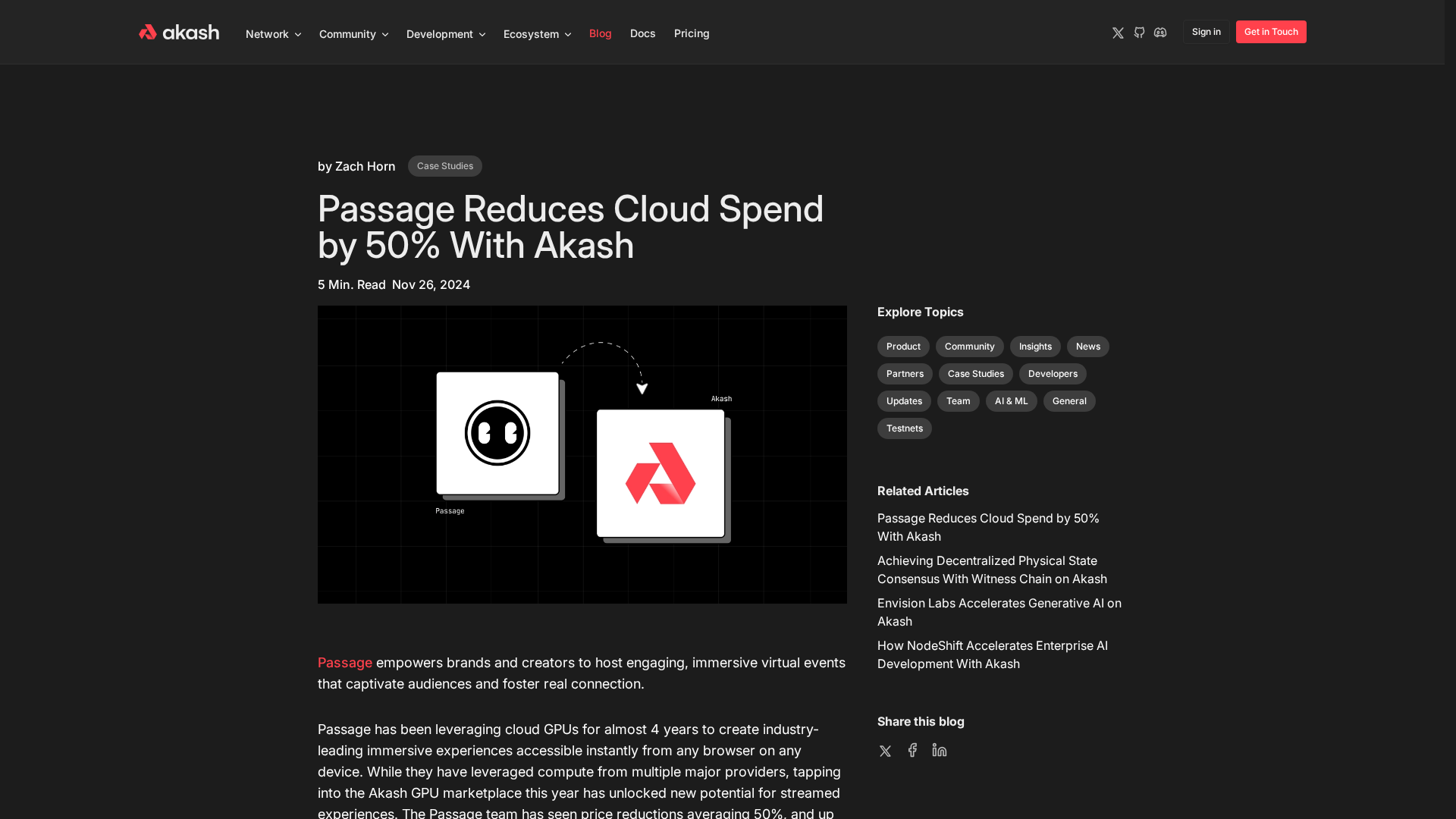
Passage cuts GPU cloud costs by up to 70% using Akash's open marketplace, enabling immersive Unreal Engine 5 events.
ProteanTecs expands in Japan with a new office and Noritaka Kojima as GM Country Manager.

Rebellions appoints Marshall Choy as CBO to drive global expansion and establish a U.S. market hub.