Topic Overview
AI-powered personalized healthcare platforms combine large language models, voice agents, and domain-specific tooling to deliver patient-facing assistants, documentation automation, and longitudinal coaching. These systems span three practical categories: personal AI assistants for triage and care navigation; clinical documentation tools that summarize encounters and populate EHRs; and AI health coaching for chronic-disease management and behavior change. Relevance and timing (as of 2026-01-24): advances in multimodal LLMs, improved retrieval/embedding stacks, and production-ready inference infrastructure have made real-time, personalized medical workflows technically and commercially viable. At the same time, stronger regulatory scrutiny, data‑privacy requirements, and demands for clinical validation shape vendor offerings and integration patterns. Key platform capabilities and representative technologies: enterprise virtual-assistant frameworks such as IBM watsonx Assistant enable no-code and developer-driven orchestration of clinical agents; voice-first providers like PolyAI and Observe.AI support natural, multilingual spoken interactions and real-time agent assist for contact centers; model and tooling stacks from Cohere and Google Gemini provide customizable LLMs and multimodal APIs for clinical summarization and question-answering; and infrastructure providers such as Together AI accelerate fine-tuning and scalable inference for privacy-preserving deployments. Practical trade-offs: achieving clinical reliability requires curated retrieval layers, clinician-in-the-loop review, secure EHR connectors, and explanation/logging for audits. Deployers must balance latency and cost for real-time voice interactions against model accuracy for documentation and coaching. In practice, effective platforms combine specialized LLMs, voice and conversation intelligence, robust privacy controls, and operational workflows that keep clinicians central to care decisions.
Tool Rankings – Top 6

Enterprise virtual agents and AI assistants built with watsonx LLMs for no-code and developer-driven automation.

Voice-first conversational AI for enterprise contact centers, delivering lifelike multilingual agents across voice, chat

Enterprise conversation-intelligence and GenAI platform for contact centers: voice agents, real-time assist, auto QA, &洞

Enterprise-focused LLM platform offering private, customizable models, embeddings, retrieval, and search.

Google’s multimodal family of generative AI models and APIs for developers and enterprises.

A full-stack AI acceleration cloud for fast inference, fine-tuning, and scalable GPU training.
Latest Articles (75)
A vendor‑agnostic guide to the 14 best AI governance platforms in 2025, with criteria, comparisons, and practical buying guidance.
Overview of the Gemini CLI v0.36.0-preview release series, highlighting architectural, CLI, and UI changelogs across multiple pre-release versions.
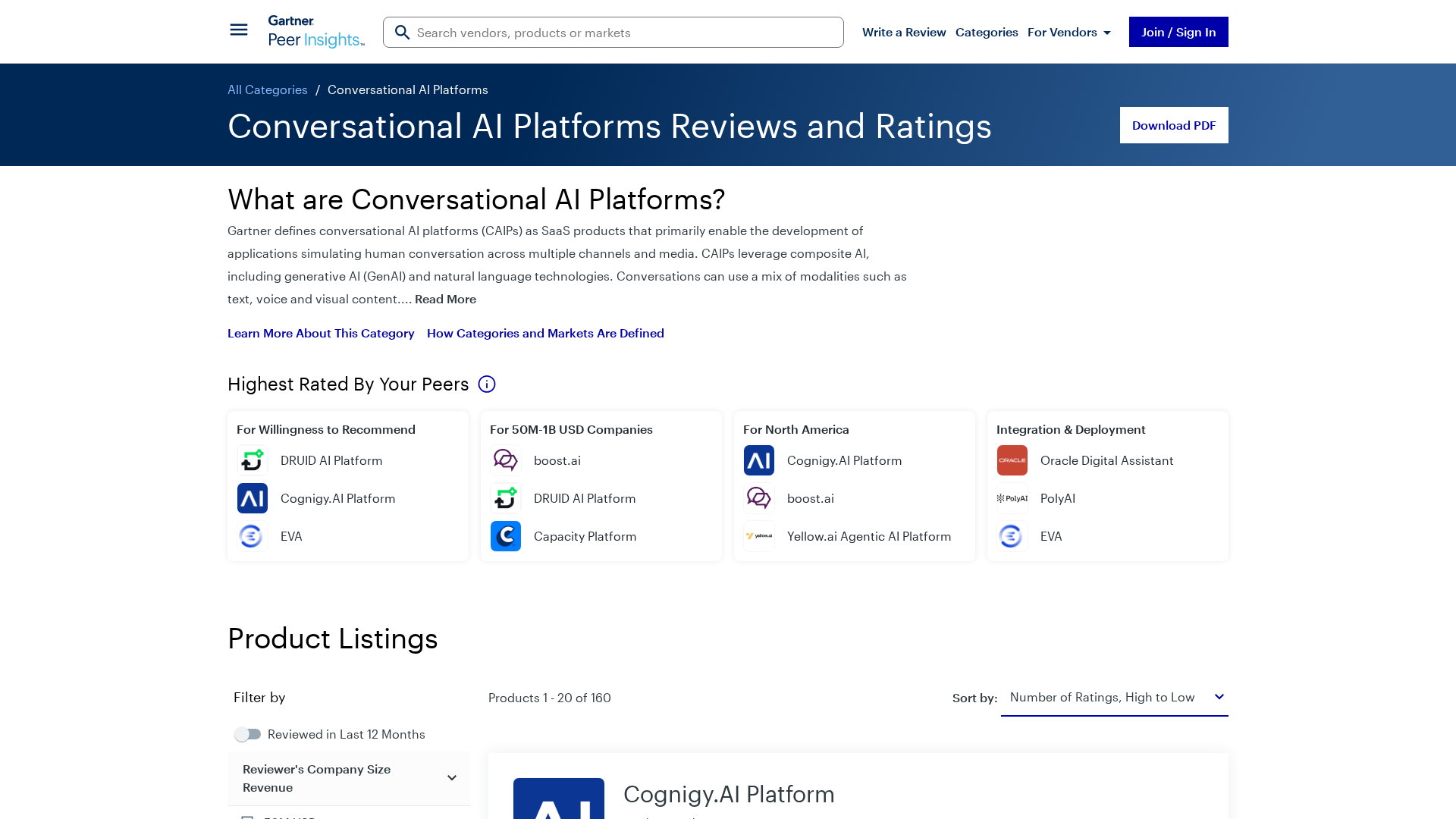
Gartner’s market view on conversational AI platforms, outlining trends, vendors, and buyer guidance.

Baseten launches an AI training platform to compete with hyperscalers, promising simpler, more transparent ML workflows.

Adobe nears a $19 billion deal to acquire Semrush, expanding its marketing software capabilities, according to WSJ reports.