Topic Overview
Enterprise GenAI cloud platforms (Google Cloud Gemini, Microsoft Azure, AWS Bedrock) are the managed foundations organizations use to run large language models, host embeddings and retrieval services, and integrate model-driven workflows with enterprise data and controls. As of 2026-06-24 this topic sits at the intersection of AI Data Platforms, Decentralized AI Infrastructure, and AI Security Governance: teams must choose between integrated cloud stacks that simplify operations and hybrid or decentralized approaches that reduce vendor lock‑in and support regulated use cases. Key trends: increasing adoption of agentic workflows, wider use of private/custom models, and a stronger focus on continuous governance, observability, and compliance. Platform decisions now pivot on fine‑tuning and retrieval tooling, inference scale/cost, data residency, and auditability rather than raw model quality alone. Representative tools and roles: Cohere and Together AI provide enterprise LLMs, embeddings, and scalable training/fine‑tuning; Bedrock, Gemini and Azure offer managed model catalogs, embedding services, and integrated security controls; Kore.ai and Yellow.ai focus on building and orchestrating multi‑agent workflows and customer/employee automation with governance and observability; GPTConsole and LangChain supply developer SDKs, APIs and frameworks for agent engineering, event chaining, and lifecycle management; Xilos and Together enable more decentralized or specialized inference/training infrastructure; Monitaur centralizes policy, monitoring and vendor governance for regulated industries; Tabby supports local‑first, self‑hosted assistants and model serving for sensitive code and IP. Choosing among cloud-first or decentralized stacks requires balancing operational simplicity, developer velocity, model customization, and the audit/controls demanded by security and compliance teams. This comparison helps procurement and engineering teams map platform capabilities to governance, data, and agentic AI requirements.
Tool Rankings – Top 6

Enterprise AI agent platform for building, deploying and orchestrating multi-agent workflows with governance, observabil

Enterprise agentic AI platform for CX and EX automation, building autonomous, human-like agents across channels.

Developer-focused platform (SDK, API, CLI, web) to create, share and monetize production-ready AI agents.

Enterprise-focused LLM platform offering private, customizable models, embeddings, retrieval, and search.

A full-stack AI acceleration cloud for fast inference, fine-tuning, and scalable GPU training.

Insurance-focused enterprise AI governance platform centralizing policy, monitoring, validation, vendor governance and证e
Latest Articles (97)
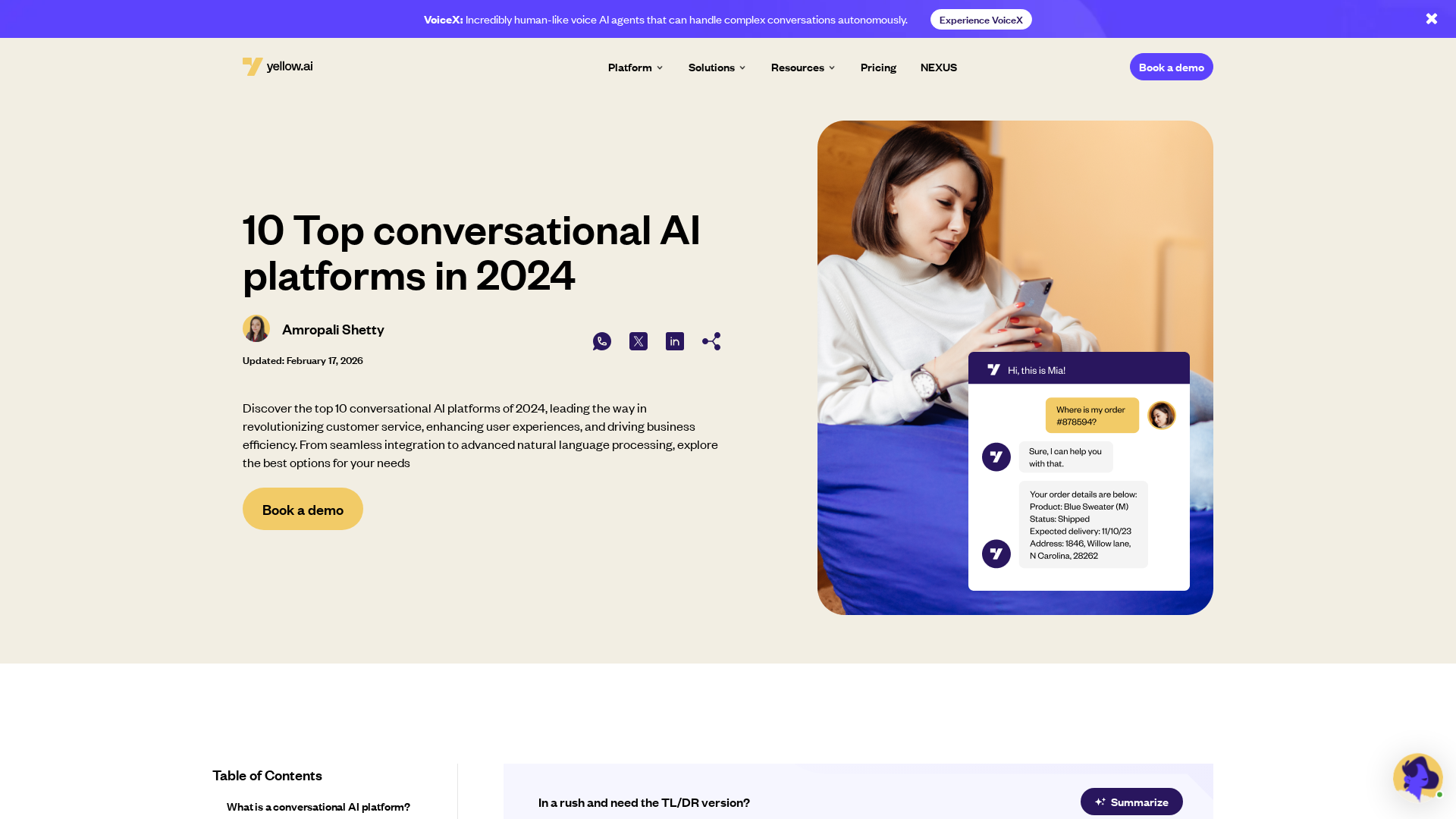
A concise guide to the top 10 conversational AI platforms in 2024, with features, benefits, and use cases.
OpenAI’s bypass moment underscores the need for governance that survives inevitable user bypass and hardens system controls.
A call to enable safe AI use at work via sanctioned access, real-time data protections, and frictionless governance.

Baseten launches an AI training platform to compete with hyperscalers, promising simpler, more transparent ML workflows.
Explores the human role behind AI automation and how Bell Cyber tackles AI hallucinations in security operations.